Home - CO2List.org   Fullest list of carbon dioxide free on the web

Send us your comments & questions


CARBON FOOTPRINT CALCULATORS
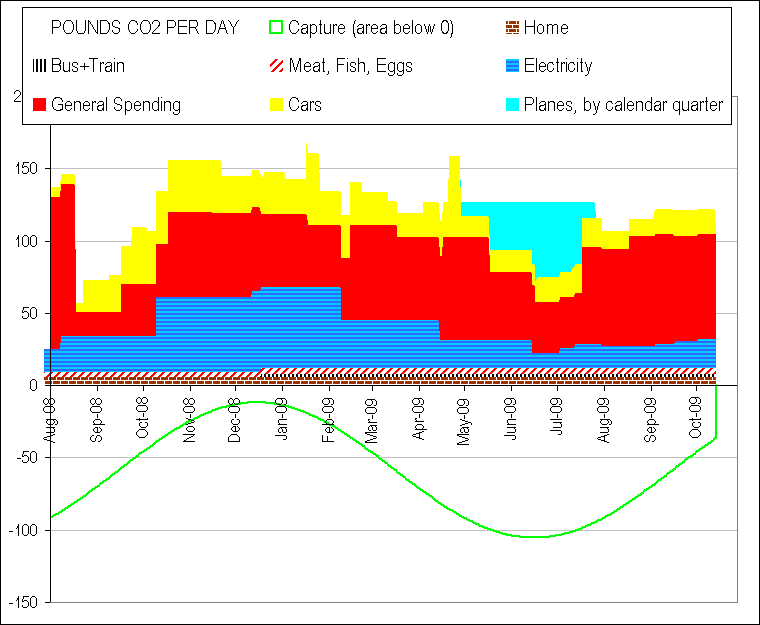
 

TRENDS IN CO2 OVER TIME


There are many calculators on the web. Only two show your trend in CO2 over time. The trend lets you see your improvements.

CarbonDiet.org and TheCarbonAccount.com


CarbonDiet has attractive graphs and easy data entry. You may want some old electric bills to get meter readings from the past. It also asks for airplane trips and gasoline records if you have them. You get an immediate graph of CO2 day by day, as far back as you have records. Keep coming back to add to your graph. Some nice features include (A) plotting CO2 each day, though somewhat smoothed with a moving average, (B) having national data for Australia, Canada, Ireland, UK, US, and (C) letting your car's MPG change over time (especially as you become a more gas-conscious driver). They explain their methods and offer CO2-saving suggestions.


They ask you to write down the gallons when you buy gasoline/petrol; rather than just miles traveled. You will want to estimate when you forget the number of gallons, or your graph will be incomplete. They say correctly that people usually fill the tank when they buy gas (and they have fixed a previous bug on the timing of gas consumption).


Both CarbonDiet and CarbonAccount let you enter meter readings from electricity and natural gas, as well as airplane flights and cars. They omit trains, buses, food, and everything else you buy.


CarbonAccount similarly has attractive graphs and easy data entry. Use Internet Explorer; they're having a problem with Firefox. If you have car maintenance bills, but not gasoline records, you can enter mileage from the old bills, and it divides by MPG to show gasoline. The site asks for a UK postcode and car number (foreigners can get good approximations by using postcode SK1 3EH, and car AB51 DVL from UKCar.com). They average all data by month, so it is not as detailed as CarbonDiet. They discuss future desired features, and are working on a Facebook application. They also explain their methods.


Both sites have Open Source code, so you can improve them. CarbonAccount uses Django, Python, SQL. CarbonDiet uses Ruby on Rails.


TOTAL CO2 FOR A YEAR


Dozens of other websites do not show CO2 trends, but simply estimate your total CO2 emissions during a year. The systems above, which show your improvements, make it easier to stay motivated.


All the calculators use low CO2 factors from just the direct burning of fuel, which exclude the full lifecycle of emissions, such as refining of petroleum and uranium, methane from gas pipelines and hydroelectric reservoirs, etc. You can compare direct fuel emissions to the more complete life-cycle emissions in the table below. A more flexible calculator would offer a choice of narrow or complete CO2 emission factors.


A good orientation to a few calculators is at http://www.grist.org/article/take-a-number/ which recommends Bonneville Environmental among the full-year calculators.


The final section of this page compares some of the calculators' assumptions.


Site which Compares 12 Ecological and 10 CO2 Footprint Calculators

http://www.esd.rgs.org/link6.html


Ecological Footprint Calculators (12)

1. Environment Agency http://www.environment-agency.gov.uk/fun/370863

2. Earth Day Ecological footprint Quiz http://www.earthday.net/footprint/index.asp#

3. Global Footprints http://www.globalfootprints.org/issues/kidsquiz/kidsquiz1.htm

4. Powerhouse Museum – Bigfoot http://www.phm.gov.au/ecologic/games.htm

5. New Scientist http://www.newscientist.com/hottopics/environment/quiz2.jsp

6. Eco Foot http://www.demesta.com/ecofoot/eng/engframe.htm

7. Mountain Equipment Co-op – Ecological Footprint Calculator http://www.mec.ca/Apps/ecoCalc/ecoCalc.jsp

8. LEAD International http://www.lead.org/leadnet/footprint/food.cfm

9. Ecology Fund http://ecologyfund.com/ecology/res_bestfoot.html

10. Ecological Footprint Lifestyle Calculator http://www.bestfootforward.com/footprintlife.htm

11. The Personal Environmental Impact Calculator http://ans.ep.wisc.edu/~eic/personal.impact.html

12. Redefining Progress http://www.rprogress.org/programs/sustainabilityindicators/ef/Footpdist


Carbon Footprint Calculators (10)

1. Best Foot Forward http://www.bestfootforward.com/carbonlife.htm

2. The National Energy Foundation – Energy to Carbon Dioxide Converter http://www.natenergy.org.uk/convert.htm

3. Global Action Plan http://www.carboncalculator.org

4. Future Forests http://www.futureforests.com/acatalog/index_world_calculator.asp

5. International Council for Local Environmental initiatives (ICLEI) – Personal Carbon Dioxide Calculator http://www3.iclei.org/co2/co2calc.htm

6. Centre for Alternative Technology (CAT) – Carbon Gym http://www.cat.org.uk/carbongym/carbongym.tpml?section=reception

7. Safe Climate – Carbon Footprint Calculator http://www.safeclimate.net/individual.php

8. Travel Calculator http://www.travelcalculator.org

9. Choose Climate http://www.chooseclimate.org/flying/mapcalc.html

10. Climate Care http://www.climatecare.org/calculator/index.cfm


Site which Compares 4 CO2 Footprint Calculators

http://www.carbonrationing.org.uk/wiki/web-based-carbon-accounting


My.CarbonRationing.org.uk

ActOnCO2.direct.gov.uk

CarbonDiet.org

TheCarbonAccount.com


Final Words


Multipliers in Various Calculators, Compared to each other and CO2List.org estimates

Automobile Gasoline

Electricity

Air Flight, kg CO2 per passenger kilometer, Economy. Multiply by 3.5 for lb/mile

High Altitude (Radiative Forcing) Index

Class of Seat, Multiplier for Emission, Based on Seat Sizes


lb CO2 / US gallon

kg CO2 per liter

lb CO2 per kWh

kg CO2 per kWh

204 km, 127 miles1

1,001 km, 622 miles

5,001 km, 3,107 miles

17,100 km, 10,625 miles2

Economy

Overseas Business

Overseas First


Most Complete: Fuel, Vehicle & Infrastructure, from CO2List.org  (methods)

(exponential airplane formula based on data in Chester 2008)

36.1

4.3

1.67 US

0.76

0.88

0.36

0.29

0.46

3.9

1.00

2.14

3.14


Include Direct Fuel & High Altitude Effects

Direct Fuel only, from CO2List.org  (methods)

(exponential air, based on data in Chester 2008)

19.6

2.3

1.37 US

0.62

0.60

0.24

0.19

0.21

2.7

1.00

2.14

3.14


Calculators with Fairly Precise Data


CarbonDiet.org  (methods)

(air from CarbonPlanet Ross 2007)

19.4

2.3

1.19 UK

0.54

0.45

0.30

0.32

0.32

2.7

1.00

2.10

3.40


TheCarbonAccount.com  (methods)

(air from DEFRA & Atmosfair)

20.1

2.4

1.16 UK

0.53

0.41

0.41

0.27

0.30

2.7

1.00

1.40

1.60


Bonneville B-E-F.org  (methods)

19.6

2.3

1.36 US

0.62

0.31

0.23

0.23

0.23

2.0

1.00

1.00

1.00


EPA  (methods), no airplanes

20.4

2.4

1.43 US3

0.65


ChooseClimate.org, only 1 flight at a time


1.14

0.49

0.35

0.33

3.0

1.00

1.49


Atmosfair  (methods), only airplanes

(fuel calculated from exact route taken)


0.25


0.30

3.0

1.00

1.88

2.50


The following use broad averages, not actual kWh, MPG, or flight length, so they are very imprecise


Al Gore's Inconvenient Truth  (methods)

(air from World Resources Institute GHG Mobile)

19.6

2.3

1.34 US4

0.61

0.43

0.16

0.09

0.05

1.0

1.00

1.00

1.00


SafeClimate.net

 (air from World Resources Institute GHG)

19.6

2.3

1.34 US4

0.61

0.64

0.64

0.64

0.64

unknown

1.00

1.00

1.00


Nature Conservancy  (methods)

unknown


1.34 US4

0.61

0.80

1.00

0.20

0.06

1.0

1.00

1.00

1.00


1Shortest flight shown is Seattle to Vancouver, 204 km.

2Longest flight shown is London to Sydney, 17,100 km. "Most Complete" estimate for flights uses an exponential formula.

3US average is shown. EPA uses mix generated in each of 26 eGrid subregions although subregions share power across each of the 5 major grids.

4US average is shown. Calculators use mix generated in each of 51 states, not mix used in relevant grid (US has only 5 major power-sharing grids).


More comparisons (and graphs) are in a spreadsheet, at the bottom of the "Air" tab.


The calculators are actually misnamed. They do not estimate Carbon; they estimate CO2-equivalent, which is what you want anyway, to address global warming. The tradition has always been to call them Carbon calculators.